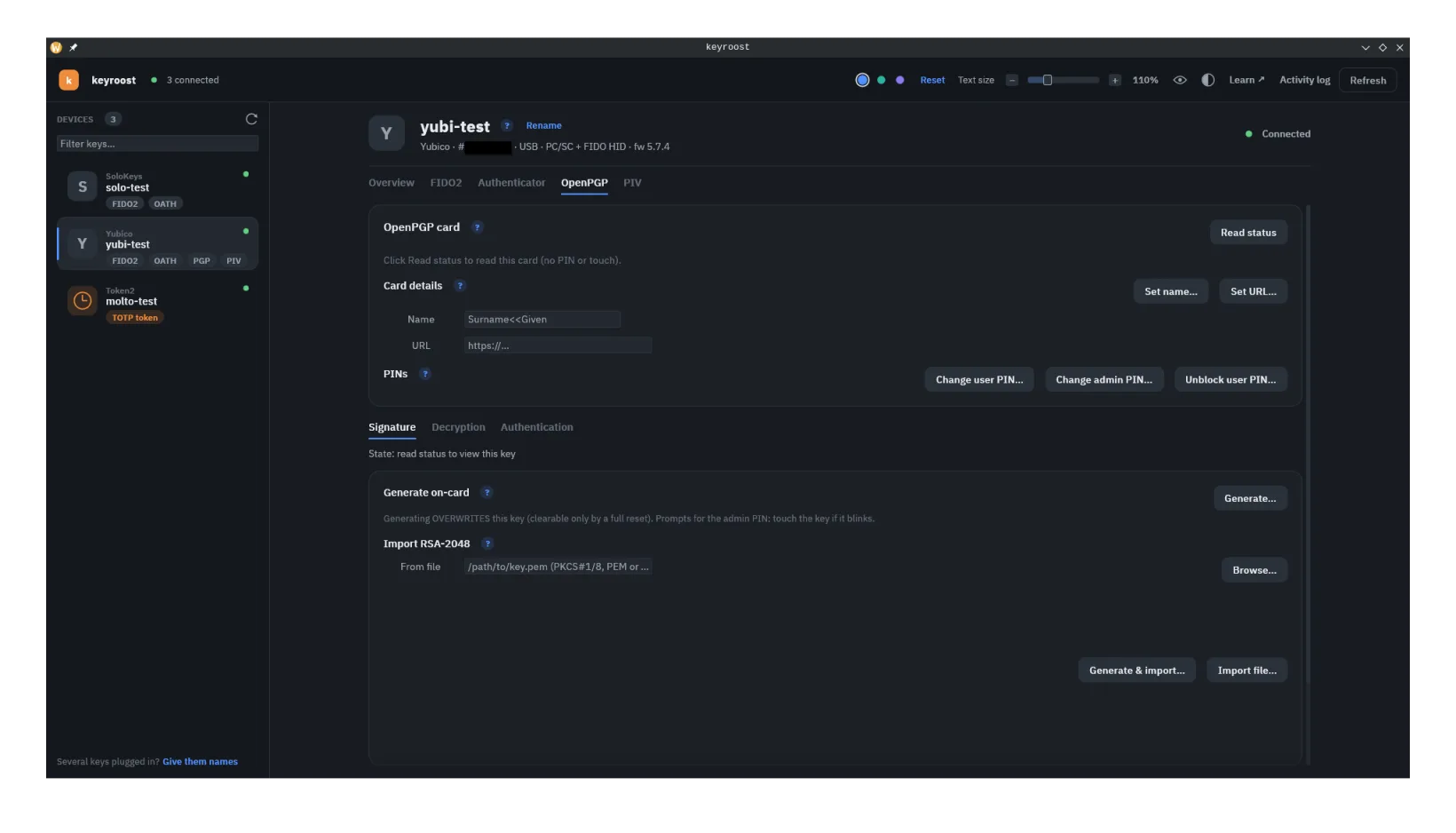
What it is
The OpenPGP Card (v3.4) is a smart-card application that holds up to three private keys and performs operations with them on-device:
- Signature key — sign email, files, and git commits/tags.
- Encryption key — decrypt messages and files addressed to you.
- Authentication key — commonly used for SSH login.
Because the private keys never leave the card, a compromised laptop can ask the card to sign or decrypt while it's present, but can't walk away with the keys themselves.
Generate on-card vs. import
- Generate on-card — the key is born inside the device and is never exportable. Best for new keys; nothing to leak.
- Import an existing key — load a key you already use. Convenient, but the private key existed off-card first, so its earlier exposure still counts.
The card uses a user PIN (day-to-day) and an admin PIN (management), each with its own retry counter that locks the function after too many wrong tries. How key PINs work →
What keyroost does with OpenPGP
Read card status and a slot's public key, and verify
a PIN without changing anything; generate keys on-card in any
algorithm the card accepts — RSA 2048/3072/4096, Ed25519, X25519, NIST P-256/384/521,
secp256k1, brainpool — the choice offered from the card's own algorithm list
(keyroostctl openpgp algorithms), or import an RSA-2048
key by host keygen or from a PKCS#1/PKCS#8 PEM/DER file, for the sign, decrypt, or
auth slot (--slot decrypt, --slot auth);
sign (SHA-256 or
SHA-1), decrypt, and authenticate (client/SSH
signature with the Authentication key); set cardholder name / URL; register a key for
GnuPG; change the user or admin PIN and unblock a
locked PIN (via the admin PIN / PW3); and factory-reset the applet. The
output of sign/authenticate is the card's raw signature:
PKCS#1 for RSA, r||s (not DER) for ECDSA, R||S for
Ed25519.
keyroostctl openpgp status --reader yubikey
keyroostctl openpgp generate-key --slot sign --algorithm ed25519 --yes --admin-pin-stdin --reader yubikey
keyroostctl openpgp sign --in msg.txt --pin-stdin --reader yubikey
keyroostctl openpgp authenticate --in chal.bin --pin-stdin --reader yubikey
keyroostctl openpgp change-pin --old-pin-stdin --new-pin-stdin --reader yubikey
The card byte layer is a pure-Rust, in-tree implementation of the OpenPGP Card spec (APDU + BER-TLV); RSA keygen/parsing is the one scoped host-side dependency. Host-side import of ECC keys and local signature verification are not offered; they would need new cryptographic dependencies, which this project adds only deliberately.